A very good talk from Stefan Widmann. Enjoy!

On not proving the twin prime conjecture with AutoCAD:
As an HVAC engineer by trade, [Carlos Paris] spends a lot of time in AutoCAD designing all those hidden pipes, tubes, and ducts hidden in a building’s rafters. One day, [Carlos] read of an open contest – the prize was over a million dollars – to generate a prime number with a billion digits. [Carlos] misheard this as, ‘a prime number greater than one billion’ and of course said this was a trivially easy task and opened up his favorite tool – AutoCAD – in an effort to discover the largest prime ever. [Carlos] never generated a remarkably large prime, but he did come up with a very, very cool visualization of prime numbers on a number line, as well as a great justification of the twin prime conjecture, a problem in mathematics that has remained unsolved for several generations.
[Carlos] started his investigations into the properties of prime numbers by drawing a series of circles on a number line in AutoCAD. These circles were of diameters of all the integers, and going down the number line, these circles started to have an interesting, chaotic pattern (see above picture). [Carlos] found that whenever two circles intersected, that position was a prime number. It’s really nothing more than a Sieve of Eratosthenes, but it’s a very cool-looking visualization nonetheless.
Looking deeper into his graph, [Carlos] discovered there were certain primes that had another prime number just two places down the number line. For example, the numbers 3 and 5, 29 and 31, and 41,and 43 are twin primes, as the difference between the primes is only 2. The idea there are infinitely many twin primes is a famous unsolved problem in mathematics – it’s obvious it must be true, but no mathematician has yet come up with a proof of this conjecture.
[Carlos] looked at his number line and simplified it to a generic prime number. By taking a generic number line and overlaying the multiples of other prime numbers on this graph, [Carlos] had a very, very clever way of understanding exactly how twin primes come into existence.
In the end, [Carlos] is no closer to proving the twin prime conjecture than anyone else. We’ve got to hand it to him, though, for nerding out with an engineer’s favorite tool – AutoCAD – and managing to derive some fairly obscure mathematics on his own.
After the break you can see [Carlos]‘s videos describing the though process that went into his creation. Very, very cool work.
Discrete FPGA will probably win the 7400 logic competition:
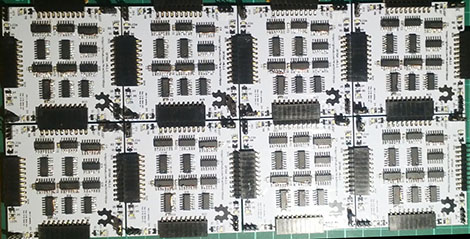
For this year’s 7400 logic competition, [Nick] decided to build an FPGA out of logic chips.
Perhaps a short explanation is in order to fully appreciate [Nick]‘s work. The basic component of an FPGA is a slice, or cell, that performs boolean operations on its input and sends the result on its output. The core of these slices is a lookup table – basically a truth table that stores the result of every possible input combination.
One very easy way to implement a lookup table is to use a RAM or EEPROM chip. By tying the address lines of an EEPROM to the input and the data lines to the output, it’s possible to create a single slice of an FPGA very easily.
Unfortunately for [Nick], 74-series memories have long been out of production. There is another option open, though: shift registers. A shift register is basically an 8-bit memory chip with parallel inputs, so combining a shift register with an 8-input multiplexer is a very simple way to implement a 3-input, 1-output FPGA slice.
After figuring out how to tie these slices to bus lines, [Nick] needed a way to program them. Verilog or VHDL would border on insanity, so he wrote his own hardware description language. It’s certainly not as powerful or capable as the mainstream solutions to programming an FPGA, but it’s more than enough.
In the video after the break, you can see [Nick]‘s overview of his very large 8-slice FPGA while he runs a combination lock and PWM program. All the code, schematics, and board layout are up on [Nick]‘s git if you’d like to build your own.
Filed under: hardware
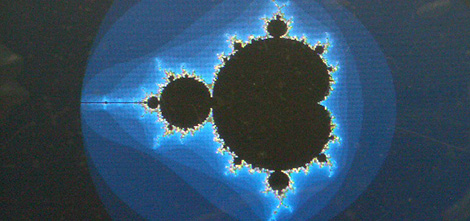 This is truly a beautiful hack! From Hack-a-day.

# Try with 2 prefixing digits
l ^[0-9]^[0-9]
# Try prefixing with possessives
l A0"My"
l A0"Your"
l A0"His"
l A0"Her"
l A0"Our"
l A0"Their"
# Try with 1, 2, 3 and 4 digits at the end, and the same with punctuation
l $[0-9]
l $[0-9]$[0-9]
l $[0-9]$[0-9]$[0-9]
l $[0-9]$[0-9]$[0-9]$[0-9]
l $[0-9]$[(){},?;.:/=+<>%$*-_]
l $[0-9]$[0-9]$[(){},?;.:/=+<>%$*-_]
l $[0-9]$[0-9]$[0-9]$[(){},?;.:/=+<>%$*-_]
l $[0-9]$[0-9]$[0-9]$[0-9]$[(){},?;.:/=+<>%$*-_]
# Try with 1 or 2 digits and 2 punctuations symbols
l $[0-9]$[(){},?;.:/=+<>%$*-_]$[(){},?;.:/=+<>%$*-_]
l $[0-9]$[0-9]$[(){},?;.:/=+<>%$*-_]$[(){},?;.:/=+<>%$*-_]